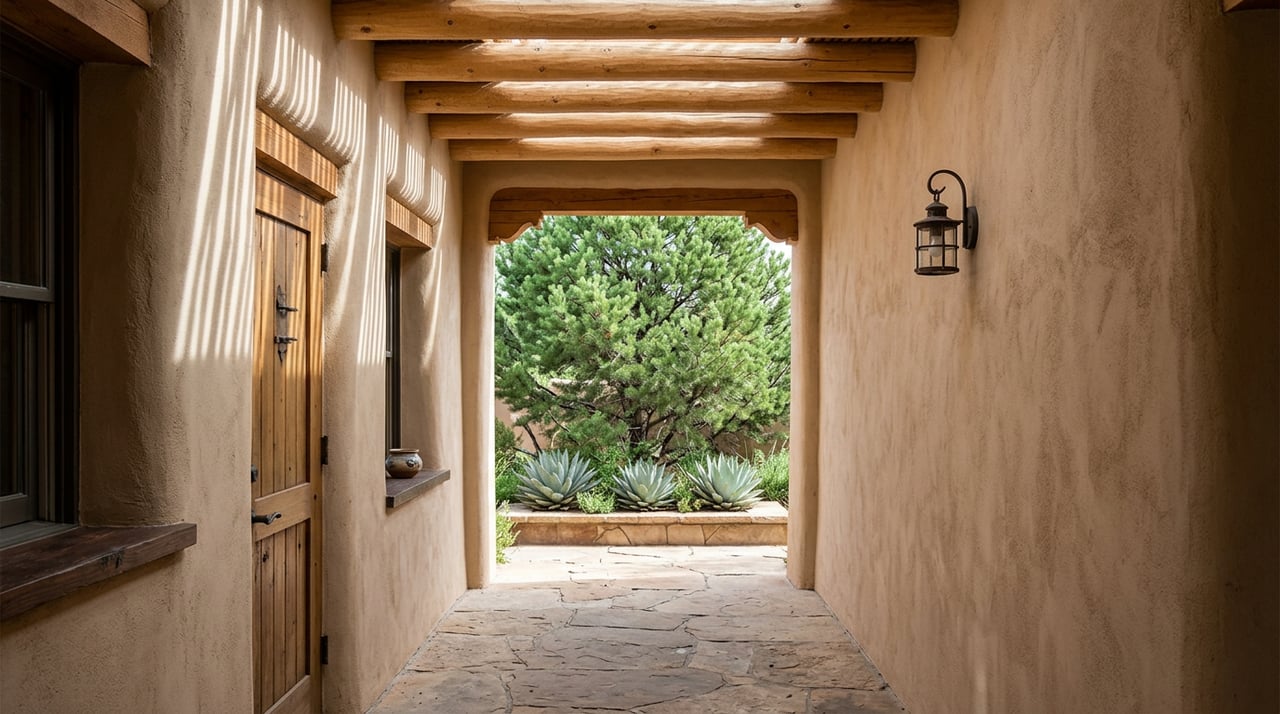
Buyers in Las Campanas tend to treat the closing table as the finish line. The wire goes through, the deed records, the keys change hands, and the assumption is that everything tied to the property, from HOA standing to club access, comes along with it in one clean package.
It doesn't work that way here.
Las Campanas runs on two approval systems that sit entirely outside the real estate transaction: the Las Campanas Owners Association's Design Review Committee, which governs anything built or changed on a lot, and The Club at Las Campanas, a privately owned, invitation-only club that has never been a package deal with the house next to it. Neither one cares what the purchase agreement says. Both can affect what a new owner is actually allowed to do, and what they'll pay to do it, months after the closing is long finished.
What Actually Transfers at the Closing Table
A simple way to see the gap: some things follow the deed automatically, and some things require a second application, a second fee, and sometimes a second waiting period.
| Item | Transfers with the sale | Requires a separate process |
|---|---|---|
| HOA assessments | Yes, dues follow the new owner, prorated at closing | Comes with a $150 transfer fee and $150 statement fee under the current fee schedule |
| Design review history | Yes, but as a liability, not a benefit | Any open or unresolved violation stays attached to the lot, not the seller |
| Club membership | No | Requires application, invitation, and Board approval, separate from home purchase |
| Water service | No | New account setup through the independent Water Co-op for most estates; Estates I and II get water through the county instead |
That third row is where most surprises happen. The fourth explains why so many buyers assume "the house comes with water" and then find out they need to open an account with an entity they've never heard of.
The Design Review Committee Controls More Than New Construction
Every Las Campanas lot sits inside a formal design review structure managed by the Owners Association, and it applies well beyond someone building a custom home from scratch. Fences, wall color, solar panels, landscaping changes, pools, exterior lighting, even significant re-vegetation work all require either an informal check-in with the Director of Design Review Services or a full submission to the Design Review Committee, depending on scope.
For a new residence, the current fee schedule lists non-refundable design review fees of $2,500 each for the conceptual, preliminary, and final stages, on top of smaller fees for less extensive projects. Those costs sit outside the county building permit entirely. They belong to the Owners Association, and skipping the process isn't a paperwork shortcut. The Association Rules give the Master Design Committee authority to fine an owner up to $10,000 when work proceeds without approval or outside the conditions of an approval that was granted.
The part that matters for a buyer under contract: that fine authority attaches to the lot, not the person who did the unapproved work. If a seller added a wall, changed a roofline, or regraded a section of the yard without going through the committee, the exposure doesn't disappear at closing. It becomes the new owner's problem to resolve. As the design review office itself puts it, the goal is to be "a contributing partner in your project," but that partnership only starts once a submission is actually on file.
This is why a design review status check belongs on the same list as a title search, not as an optional extra. The Owners Association's general manager, Kim Visser-Weinmann, and the Design and Review office contact, Simón De Agüero, are the two names buyers and their agents should be reaching before an offer goes in on anything with recent exterior work, not after.
The Club Doesn't Move With the House, Even If the Seller Belongs
The second gap is the one that catches design-conscious buyers off guard most often, because it runs against intuition. Membership at The Club at Las Campanas is private, invitation-only, and explicitly not tied to property ownership. The club states plainly that no residence requirement exists to join, and that ownership does not guarantee an invitation.
That cuts both ways. A buyer who assumes the golf, tennis, spa, and equestrian access shown in a listing photo comes bundled with the house is working from the wrong assumption. And a seller who holds a membership can't simply hand it to the buyer as part of the deal.
Historically, only Equity category memberships (Equity Golf and Equity Social) have carried any transferability at all through a property sale, and even then, the transfer has not been a straight handoff. In the club's own past membership bulletins, a member moving to reissue status received resale value based on 80 percent of the current initiation fee at the time of transfer, not what they originally paid, and the transfer itself carried the club's standard transfer fee, historically set at 20 percent. Non-equity and legacy membership categories have not carried that same transferability at all.
Initiation fees have also moved over time. Club bulletins from past years put Equity Golf and Equity Social initiation at different levels in different periods, which is exactly why relying on an old number from a listing sheet or a seller's recollection is a mistake. Club fee structures are the kind of detail that changes on the club's own schedule, not the market's, so the only reliable number is whatever the Membership Director quotes in writing on the day a buyer actually applies.
What to Request Before You Write or Accept an Offer
For buyers, sellers, and anyone advising them, a short list of documents closes most of this gap before it becomes a post-closing problem.
- A current design review status letter from the Owners Association confirming whether any violations, open applications, or unapproved work are on file for the specific lot.
- Written confirmation of which estate's CC&Rs apply. Las Campanas is made up of 29 separate estates, each with its own covenants layered on top of the master association's rules, so two homes a few hundred yards apart can carry different requirements.
- A membership status letter directly from the Club's Membership Director if club access matters to the purchase decision at all, spelling out current initiation fees, transfer terms, and any waiting period.
- Confirmation of which utility provider serves the lot. The Water Co-op supplies water to most estates and handles wastewater processing community-wide, but Estates I and II get their water through the county instead.
- Clarity on rental plans if that matters long-term. Association rules require a minimum 30-consecutive-day lease, prohibit bed-and-breakfast style use, and require a copy of every lease filed with the association before it starts.
None of this shows up automatically in a standard purchase contract, and none of it is optional to skip if the buyer plans to build, remodel, or use the club.
A Few Common Questions
Does buying a home in Las Campanas include a Club membership? No. The club is privately owned and separate from real estate ownership. Membership requires an application and Board approval regardless of who owns the house.
If the seller has an Equity membership, can I take over their rate? Not automatically. Historically, transfers of Equity memberships have been valued at a percentage of the current initiation fee at the time of transfer, plus the club's transfer fee, rather than the seller's original price. Confirm current terms with the Membership Director before assuming anything.
What if the current owner made changes without design review approval? The lot carries that exposure forward. Association rules allow fines up to $10,000 for unapproved work, and it becomes the new owner's responsibility to resolve, which is why a design review status check belongs in due diligence.
Does design review apply to landscaping, or just new construction? Both. Significant vegetation changes, exterior equipment, and landscaping projects can require informal or formal review depending on scope, the same as new construction or additions.
Las Campanas rewards buyers who do this homework early. The lots are large, the architecture is genuinely distinctive, and the privacy is real. None of that changes the fact that a deed transfer and a design review clearance are two different documents, issued by two different offices, on two different timelines.
If you're comparing a specific Las Campanas property and want help sorting out which approvals are already in order and which ones still need a phone call, Destinee Tran can walk through the estate-specific documents with you before you write the offer, not after. Let's Connect.